

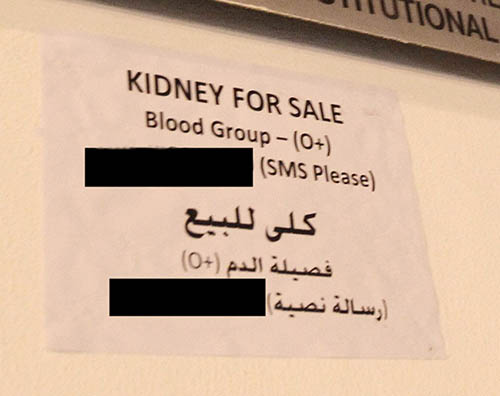
A man who put up posters advertising his kidney for sale has told the GDN he wants to raise enough money to pay for his mother’s cancer treatment.
The GDN first broke the story on Monday after contacting the 23-year-old Bangladeshi using a mobile number included on one of the posters.
He said he wanted BD15,000 in return for one of his kidneys, but was initially reluctant to discuss the reason and described it as a family
matter.
However, he has now opened up to the GDN to reveal that he was an illegal worker who needed money to pay for his mother’s medical treatment.
“I can get in trouble for this, but I have no other options left,” he said on condition of anonymity.
“My mother is a cancer patient and I desperately need money for her treatment.
“I am the only breadwinner in the family and have to support three young brothers and two sisters.”
He said he was so desperate that he was even prepared to lower his price to BD10,000 if a legitimate buyer came
forward.
“If there is a person suffering from renal failure interested in buying my kidney, I will lower the price to BD10,000,” he said.
Desperation led him to put up posters outside a private medical centre near Salmaniya Medical Complex, as well as outside Naim Health Centre, advertising his kidney.
“Kidney for sale – blood group (O+),” say the posters, along with a mobile phone number.
The Bangladeshi said his residence permit had expired three months ago and he was now working as a fruit seller.
“I earn around BD80 selling fruit, but I need more money for my mother’s treatment,” he said.
“It was my decision to print those posters and offer my kidney for sale to anyone interested in Bahrain.
“I am scared to contact my embassy or any association because of my visa status and thought this was the best way to collect the funds.”
The Bangladeshi said he was aware of the six-month amnesty that allows illegal residents to leave the country until December 31, but wanted to remain in Bahrain because he thought there was more chance of selling his kidney at a
higher price.
He added he was ready to undergo a transplant operation in Bahrain or another Gulf country, but had actually received calls from people offering to donate him money after seeing the
posters.
“I received several calls from people who wanted to help me financially after checking the posters in Manama,” he said.
After his story appeared in the GDN he was contacted by the National Committee to Combat Human Trafficking yesterday to determine whether he was a victim.
Organ donation is widely practised in Europe and the US, with donors consenting to their organs being used after their death.
However, there is some reluctance in the Arab world due to conflicting opinions among Islamic scholars over whether Muslims can donate their organs.
This has hindered attempts to roll out organ transplant programmes and some patients have resorted to travelling abroad for surgery, which can often lead to complications.
sandy@gdn.com.bh
&uuid=(email))