

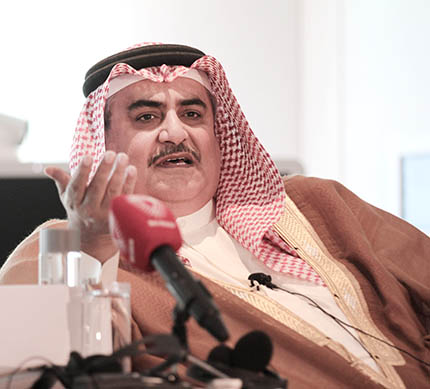
Manama: The only solution to the “regional war” with Iran is ceasefire talks, according to Bahrain’s Foreign Minister Shaikh Khalid bin Ahmed Al Khalifa.
Bahrain is prepared to start a dialogue with Tehran if the Persian state is willing to make the first step to end all hostilities – political and military, he said.
“There had been many moves from the GCC and the Arab League towards such a talk, but we never came to the right time or the right formula,” said Shaikh Khalid.
“All diplomatic statements from the Iranian foreign minister and president are contradicted by the top leadership of the country.
“We are countries in a state of war, defending our territories, our people and our vital interests and when we come to talk about such important matters, if we are not necessarily representing the right views, it will be waste of time.
“In a state of war the only way to initiate a talk is with a talk of ceasefire – a ceasefire of all sorts, a political ceasefire and a military ceasefire.
“Once we come to this, as we have always said in Bahrain, if they take one step we will take two towards them as at the end of the day they are our neighbours.”
Shaikh Khalid was speaking yesterday during a presentation panel on ‘Peace in the Region: Ways to Achieve it’, which was organised by think tank International Peace Institute (IPI) at its Bahrain Financial Harbour office.
The session was also attended by former Turkish President Abdullah Gul and IPI president Terje Roed-Larsen.
“We are in no way looking at Iran as a Shi’ite power and at ourselves as Sunni powers,” added Shaikh Khalid.
“We are not looking at this as a Persian-Arab conflict nor are we looking at them as Persians or our enemies, but people in their own country have their own problems due to some of the policies of their rulers.”
Shaikh Khalid stressed the importance of rooting out extremist ideologies in the region, which was experiencing a dangerous movement that justified terrorism as legitimate and necessary.
“This region in the 50s to the 70s was catching up with the rest of the world, and was moving swiftly and surely towards modernity,” he added.
“Challenges started putting pressure on the region – the dictatorship in Egypt and Iraq, the Iranian revolution, the Iran-Iraq war, the Jihadist movement in Afghanistan – all of these cast a shadow on our societies.
“These problems were lying low and were not dead even at that time – it was all part of that Pandora’s Box which was opened and is now difficult to close.
“We are left [to deal with] extremism, ideologies, pain and diseases hurting our societies, which should be addressed through education and by encouraging people’s aspiration [to fight terror] and once we overcome these we will be able to take that first step towards moving forward.”
While describing the Islamic State as the biggest threat to the region, Shaikh Khalid said that Bahrain was facing a “state-sponsored terror”.
“Organisations like Hizbollah, fully supported and financed by Iran undermine the security or take over the states in the region, and Lebanon is an example,” he said.
“We have seen how they are trying to undermine the Gulf by stashing and hoarding weapons in Kuwait, smuggling explosives and training operatives for Bahrain and the rest of the Gulf.
“This is the challenge that we have to address in order to clear the field for an architecture that we aim to build, or else we will continue to face problems.
“These problems take a religious or sectarian or in even an ethnic cloak, which is not – instead these are political aspirations of certain groups with an agenda.”
The session was attended by diplomats, religious and business leaders and government officials.
raji@gdn.com.bh
&uuid=(email))