

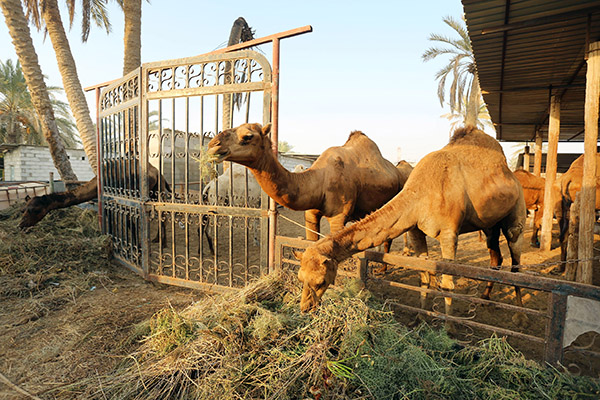
Manama: Camel milk connoisseurs are facing a shortage of their favourite drink as Bahrain’s niche dairy farmers struggle to meet demand.
Proponents of drinking camel milk claim it carries a whole raft of health benefits, from boosting the immune system to lowering the risk of diabetes and even curing autism.
However, restrictions on camel imports in the wake of the Middle East respiratory syndrome coronavirus (Mers-CoV) outbreak have left Bahrain’s handful of camel farmers selling out of milk quicker than they can
produce it.
Camels yield around one-fourth of the milk that a cow can – and in the summer that number falls even further, according to seasoned camel farmer Ali Yousif Al Saigh.
Operating out of a large farm in Abu Saiba, Mr Al Saigh told the GDN that he has been in the camel milk business for more than a decade and said that he wants to expand, but is unable due to import restrictions.
“Most times, if you just come by, you won’t find any camel milk left,” he said.
“Because it is the summer, we can get about 20 to 30 litres of milk a day, otherwise it’s around 30 to 40 litres.
“It is not expensive – it costs BD1 for 850 millilitres.
“People really like it as it is fresh and healthier than other milks – it is good for diabetics, as it has more calcium and less fat.
“We want to produce more milk but we just can’t breed the camels that fast.
“Before, we would just import more camels from Saudi, Oman or Qatar but there are restrictions now because of the coronavirus.”
First identified in Saudi Arabia in 2012, Mers-CoV has killed 527 people globally with 1,493 confirmed cases, according to the latest World Health Organisation (WHO) figures.
Strains of Mers-CoV have been identified in camels in several countries, including Egypt, Oman, Qatar and Saudi Arabia.
Although it is not yet fully understood how people become infected with the deadly disease, WHO research indicates that humans become infected through direct or indirect contact with infected dromedary camels.
Restrictions on the importation of camels were put in place in response to this, Works, Municipalities and Urban Planning Affairs Ministry animal wealth directorate head Dr Salman Abdulnabi Al Khuzaie told the GDN.
“Camel imports are very strictly regulated and with the re-emergence of coronavirus in Saudi Arabia it has only gotten stricter,” he said, referring to dozens of cases that have been reported by the Saudi Health Ministry to the WHO since the start of last month.
“We are still worried about camels so the restrictions have been in place since last year.
“Research into the virus is still ongoing but we do know that the virus can be transmitted from camels to humans.
“The reason why we are being so strict is because camels can have the virus and be symptom-free, so it is hard to spot an infected animal.
“This is a contingency plan and we can’t ease the restrictions until more is known about the virus and how it spreads.”
Although he admitted that the restrictions had made his trade more difficult, Mr Al Saigh said that they had the knock-on effect of bringing Bahrain’s already close-knit community of camel farmers closer together.
“For instance, we have 35 camels at our farm but not all of them are producing milk at the same time,” he said.
“Because of this, we have to time their pregnancies so that we don’t stop producing milk at any point throughout the year.
“After a camel gives birth it can provide a decent amount of milk for about a year but after that we have to wait a year for that same camel to get pregnant again before it can produce again.
“Sometimes if the timing is off we trade with other farmers so that we can all keep producing throughout
the year.
“In this way it has brought us all closer together.”
Other camel products, such as meat, were only rarely sold as the animals were in such short supply, said Mr Al Saigh.
“We do sell camel meat but it is usually sold before it has even been slaughtered,” he told the GDN.
“No one will slaughter a female and no one really wants to sell them.
“The only time we have meat is when a camel has given birth to a male – we keep the males around because the camels will stop producing milk without their offspring around.
“But after a year we slaughter it and when we do the news goes round so fast – people buy 15 kilos at a time.”
Strangely, another product that is sometimes in demand is the camel’s urine.
“People also come for the urine – we don’t sell it but if someone wants it they can have it,” said Mr Al Saigh.
“People mix it with the milk as a Bedouin remedy for sickness or a stomach ache – it is even used to rub on the skin to make it softer and some say it is good for cancer.”
The WHO has issued guidelines explicitly warning against potentially unsafe practices such as drinking
camel urine.
“Until more is understood about Mers-CoV, people with diabetes, renal failure, chronic lung disease, and immunocompromised persons (with an impaired immune system) are considered to be at high risk of severe disease from infection,” it said in a statement.
“Especially in the Middle East, this group of people should avoid contact with camels, consuming raw camel milk or camel urine, as well as eating meat that has not been properly cooked.”
&uuid=(email))