

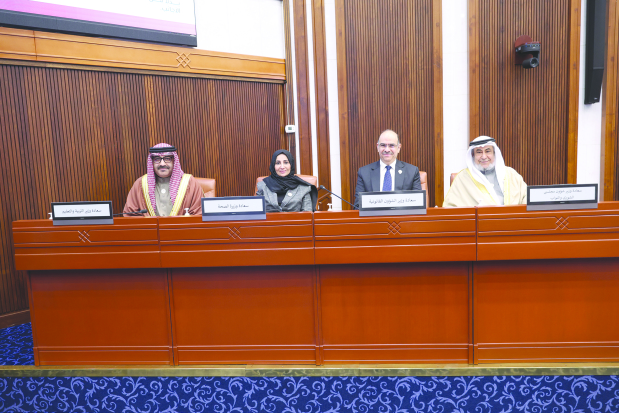
A commitment towards a long-term Bahrainisation strategy has been outlined by senior ministers.
It came as MPs claimed that not enough was being done towards having a bigger local workforce across both the public and private sectors.
Four ministers were present yesterday during a debate on the findings of an investigative committee’s findings into the subject.
MPs threw multiple accusations and pinpointed blame over what they considered to be a lack of substantial Bahrainisation plans.
Parliament and Shura Council Affairs Minister Ghanim Al Buainain, who is also politically responsible for the Civil Service Commission, stressed the importance of close co-operation between the government and the parliamentary committee.
“We received more than 2,358 sub-questions from the committee and responded to 90pc of them,” he said.
“This reflects the government’s commitment to providing the necessary data and information to support the committee’s work.”
The minister noted that the committee conducted seven field visits to various government institutions, including the Labour Ministry, the Civil Service Commission, Salmaniya Medical Complex, Alba, Asry and Bapco Energies to gather field data and examine the employment landscape across different sectors.
“This was a significant challenge given the limited time available compared to the extensive tasks the committee undertook,” he explained.
He also pointed out that the committee’s efforts coincided with three other parliamentary investigation committees operating simultaneously, collectively directing 4,706 questions to the government.
He further noted that some government entities were unable to provide certain information due to the Data Protection Act which prohibits sharing data that conflicts with legal restrictions.
“The number of expatriate employees in the public sector has decreased by 24pc since 2019,” said Mr Al Buainain.
“As of January 2025, there are 5,766 in the government sector, compared to 7,582 in 2019,” he said, highlighting the government’s efforts to prioritise employing Bahrainis while maintaining service quality.
The minister clarified that 90pc of foreign employees in the government sector were concentrated in education, higher education and healthcare.
“These are critical sectors where specific expertise may not always be immediately available among Bahrainis, but we are working to bridge these gaps,” he explained.
“We have significant reductions in the number of non-Bahraini employees since the government provided its data to the committee in December 2023.
“Hundreds of expatriates have been replaced in various government sectors during this period, covering multiple specialties.”
Mr Al Buainain reaffirmed the government’s dedication to advancing Bahrainisation.
“We are committed to replacing foreign employees with qualified Bahrainis wherever possible, ensuring that quality and operational efficiency remain uncompromised.”
Meanwhile, Health Minister Dr Jalila Al Sayyed revealed that Bahrain’s health sector is committed to the Bahrainisation of jobs through training and replacement programmes, ensuring the sustainability of healthcare services in the kingdom.
“As medical and healthcare positions in primary healthcare centres have been successfully Bahrainised, there is currently only one non-Bahraini employee in the ministry,” she added.
“A Bahraini employee is already being trained to take over that role as part of the replacement process.”
Dr Al Sayyed also stressed the ongoing efforts in government hospitals, stating that there remains a clear plan for replacing expatriates with Bahrainis.
“Most of the figures mentioned in the report have decreased due to the replacement process, which is now primarily focused on the nursing staff,” she explained.
“Around 85pc of doctors in secondary and tertiary care in government hospitals are now Bahrainis.
“Efforts are underway to replace the remaining 15pc of expatriate medical staff with qualified Bahrainis.”
She noted that more than 170 Bahrainis were currently enrolled in board certification programmes as part of the replacement plan, while 55 others have been sent abroad to specialise in advanced medical fields.
“These specialists are expected to take on their roles in the near future without disrupting the continuity of healthcare services,” the minister added.
Dr Al Sayyed reaffirmed the ministry’s commitment to training and equipping Bahrainis to meet healthcare demands, ensuring a smooth and sustainable transition while maintaining high-quality medical care for all citizens.
“Nursing in general remains a global in-demand profession.”
Also speaking, Education Minister Dr Mohammed Mubarak Juma said 3,132 Bahraini employees had been hired in recent years as part of ongoing Bahrainisation efforts.
The minister provided a breakdown of the hiring figures:
In 2020, 196 expat contracts were terminated and 203 Bahrainis were hired.
In 2021, 264 contracts were terminated and 590 Bahraini teachers were employed.
In 2022, 263 contracts were terminated, and 877 Bahraini teachers joined the workforce.
In 2023, 103 contracts were terminated and 951 Bahraini teachers were hired.
In 2024, 162 contracts were terminated and 511 Bahraini teachers were employed.
“These numbers reflect the ministry’s continuous commitment to executing its Bahrainisation plan and prioritising the interests of the education sector,” Dr Juma stated.
“The education sector still employs some expatriate teachers who are essential in serving students across government schools.”
However, he added that the ministry remains steadfast in its mission to replace expatriates with Bahrainis, with Bahrainisation in the ministry now reaching 86pc.
“This percentage is a testament to the significant progress made by the government in this regard,” Dr Juma remarked.
He also highlighted the ministry’s efforts to hire graduates from Bahrain Teachers College (BTC), which boasts a 100pc employment rate for its graduates.
“BTC is the only institution in Bahrain with a guaranteed 100pc employment rate for its graduates,” he noted.
“The ministry has provided opportunities to many Bahrainis, even those lacking prior experience, by offering training to help them prove their capabilities.
“This reflects the quality of education outcomes in Bahrain and the ministry’s commitment to developing local talent.”
He said the ministry has also been working diligently to encourage the private sector to prioritise Bahraini talent.
“We have supplied many private schools with ready-to-hire lists of qualified Bahraini candidates, particularly those who couldn’t be absorbed into government school positions.
“These candidates possess the necessary expertise to excel in private education institutions.
“We are also working to have private schools open classes for students with disabilities and we see it as an opportunity for more graduates in hearing difficulties, sign language, Braille language and physical movement to be employed.”
Dr Juma revealed that several measures have been implemented to improve the quality and quantity of scholarship opportunities over the last two academic years.
“For the first time, scholarships have been introduced as part of academic plans directed toward the US and the UK.
“We have also revised the eligibility criteria for scholarships, with the cumulative GPA now serving as the primary metric to ensure fairness in distribution,” he stated.
“We are dedicated to steadily replace expatriate teachers with Bahraini professionals while maintaining high standards in the education sector.”
Commenting on the matter, acting Labour Minister and Legal Affairs Minister Yousif Khalaf dismissed allegations that the ministry closes cases of unemployed individuals without justification.
He clarified that the Labour Ministry’s actions strictly adhere to the law and its requirements.
“There is no such thing as closing cases arbitrarily,” Mr Khalaf stated. “There are categories of individuals who qualify for unemployment benefits and others who do not,” he explained.
“The legal text is clear: compensation is only granted to those who enroll in training and successfully complete it. We are simply enforcing the law.”
The minister explained that unemployment benefits are dependent on fulfilling specific legal conditions.
“There are legal requirements to qualify for unemployment benefits. If any condition is not met, the ministry applies the law accordingly,” he said.
He pointed out the existence of a grievance committee to address disputes.
“For those who believe they have been unfairly denied benefits, there is a grievance committee to review their cases. If the committee’s decision is not in the individual’s favour, they have the right to escalate the matter to the courts,” Mr Khalaf added.
Mr Khalaf underscored the ministry’s commitment to fairness and transparency, stating that decisions regarding unemployment benefits are made based on established legal frameworks.
He reiterated that the ministry does not take decisions lightly and always ensures that its actions comply with the law.
“Our role is to uphold the law and ensure that benefits are provided to those who meet the necessary requirements. Any claims suggesting otherwise are simply unfounded.”
All 32 recommendations and 20 findings by the committee were approved and referred to the government for review.
Government Hospitals chief executive Dr Mariam Al Jalahma had to intervene to help out MP Dr Mariam Al Dhaen after she suffered a painful bout of coughing during the seven hours of debate on the topic.
Dr Al Dhaen was taken to Salmaniya Medical Complex for treatment.
Acting Parliament Speaker Abdulnabi Salman, who took the chair from Speaker Ahmed Al Musallam, warned MPs to be quiet repeatedly after an unsilenced phone continuously rang in the chamber and MPs continued talking amongst themselves as probe committee chairman MP Muneer Suroor tried to speak.
mohammed@gdnmedia.bh
Top stories for today:
Proposed law on work permit approved
Move to pump BD500 million in budget
Call to make locals top priority in jobs market
&uuid=(email))