

Parents are being urged to supervise their children’s use of electronic devices including mobile phones, tablets and video games to protect them from online predators.
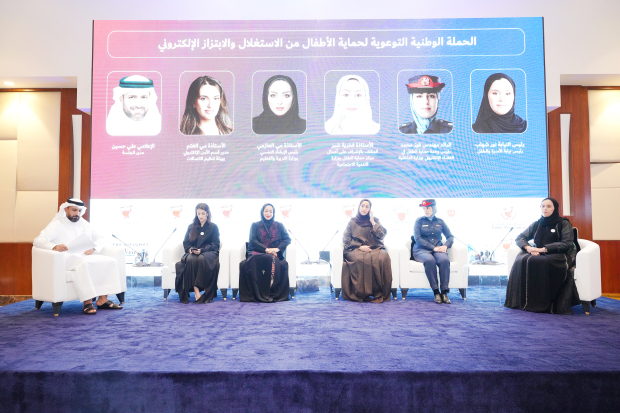
Speaking during the launch of ‘Himaya’ (Protection) initiative, at the Diplomat Radisson Blu Hotel, Residence and Spa in Manama, a panel of five experts recommended parents manage their children’s time online, rather than use the devices as a babysitting tool.
The cybersecurity campaign aims to protect children from online blackmailers and extortionists.
Family and Child Prosecution chief Noor Shehab said that there has been a rise in cybercrimes against children in recent years, given how accessible the Internet has become.
“More children are getting access to the Internet at a young age,” said Ms Shehab.
“About 20 years ago, children used to get mobile phones when they were about 12 years old.
“Now children are given devices at about four years, and some parents have started to use it as a babysitter.”
Interior Ministry’s Cyberspace Child Protection Unit chief Major Fowz Mohammed stated that Internet access means that criminals no longer need to be in people’s homes in order to commit crimes.
“Such devices give them remote access to children, who usually have phones with them all day,” Maj Mohammed said.
“They pose a threat to their physical and mental well-being, and children have no idea they are being victimised.”
Social Development Ministry’s Child Protection Centre supervisor Fakhriya Shubar stated that the main issue stems from the fact that parents use the devices to distract the children while they are off doing something else.
“Do not let them use the devices without supervision, especially at a young age,” said Ms Shubar.
“Monitor their use, and look for signs that your child is being abused or extorted online, such as change in behaviour, suddenly asking for abnormal amounts of money and spending more time online.”
For parents who discover that their children are victims of online blackmail, Education Ministry head of Psychological Counselling Mai Al Azmi said that the best way to respond is to talk to the child calmly and show kindness and empathy.
“Listen to what they have to say and then teach them how they can avoid such a situation in the future,” Ms Al Azmi said.
“Tell them you trust them and make them feel like they can talk to you when they are in trouble.
“Change any important passwords and immediately inform the authorities for help.”
Telecommunications Regulatory Authority’s Electronic Security Department director Mai Al Ghatm shared some tips on how parents can protect their children from online criminals.
“Do not save any important passwords on devices that children use,” she said.
“If possible, put a pin code or passcode on the devices and do not give it to the children, so that you can monitor their use.
“Enable two-step verification for further protection, and warn children against opening messages and links from unknown people and from talking to strangers online.”
The authorities are also urging parents of children who are being victimised online to report abuses immediately.
They can contact the Social Development Ministry’s Child Protection Centre by calling the 998 hotline, or emailing them at cpc@social.gov.bh.
Alternatively, they can contact the Interior Ministry’s General Directorate of Anti-Corruption and Economic and Electronic Security using the 992 hotline, or the Cyberspace Child Protection Unit, either by calling them directly at 17108050. Additionally, they can send a text message on WhatsApp at 33523300 or email the unit at cpcu@interior.gov.bh.
The GDN reported yesterday that since the beginning of last year, authorities have dealt with 164 cases involving child exploitation, with 66 per cent of the victims being aged 15 and under.
Bahrain joined Interpol’s International Child Sexual Exploitation (ICSE) database last month as it steps up efforts to combat online child exploitation, in line with the directives of Interior Minister General Shaikh Rashid bin Abdulla Al Khalifa.
The database is designed to support experts working on cases involving the sexual and online exploitation of children.
nader@gdnmedia.bh
&uuid=(email))