

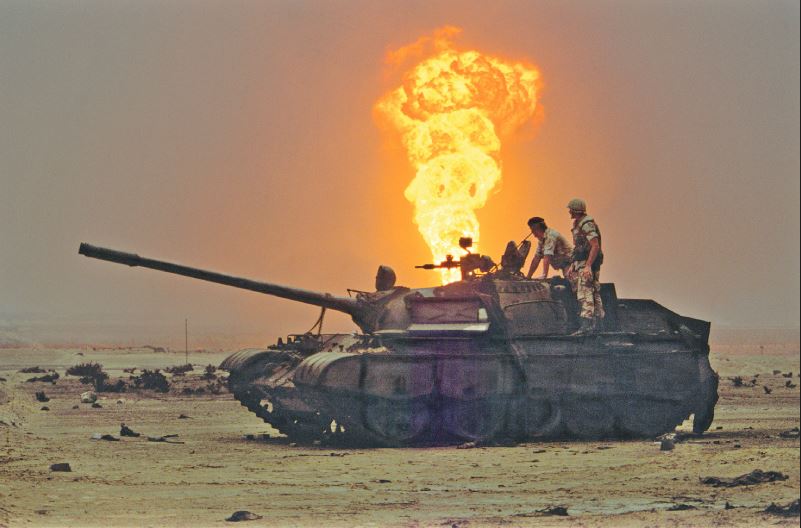
Today marks the 30th anniversary of Operation Desert Storm and Bahrainis and expatriates living in the kingdom at the time are recalling what life was like hiding for cover one moment and sneaking on to rooftops the next to watch explosions light up the sky.
Although the Gulf War started on August 2, 1990 with the bombing and invasion of Kuwait by Iraq it came to an end on February 28, 1991, following the military intervention.
This day, three decades ago, the Gulf Daily News produced two newspapers, one a special ‘war edition’.
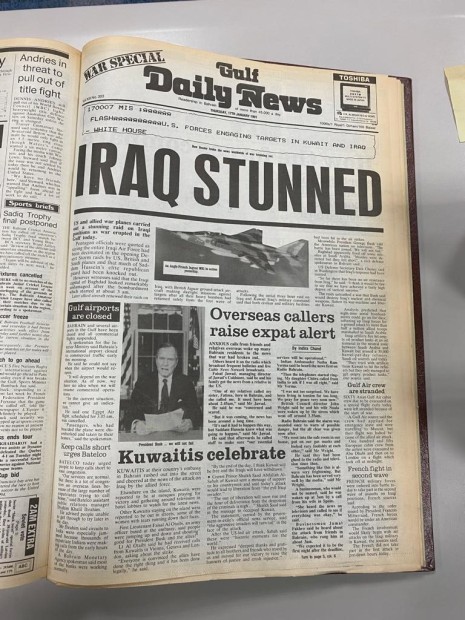
A “War Special” Edition of the GDN on January 17 1991
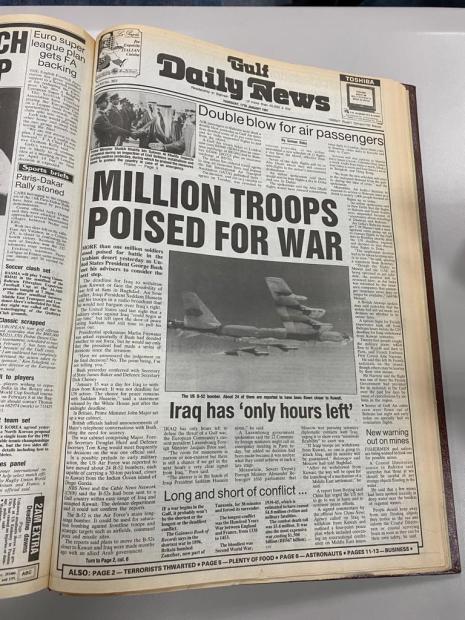
The front page of the GDN on January 17 1991
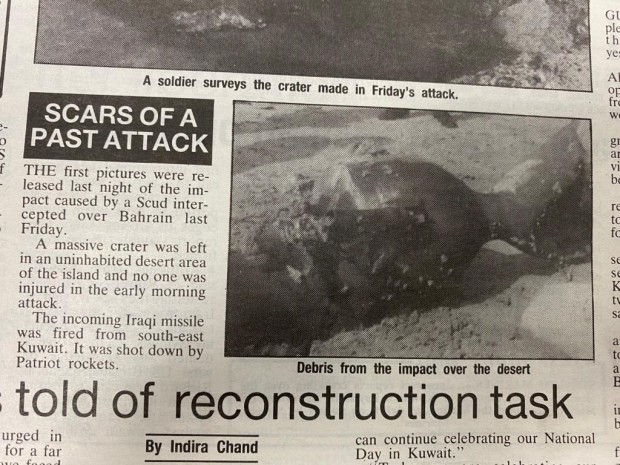
The GDN reporting the missile strike on Bahrain
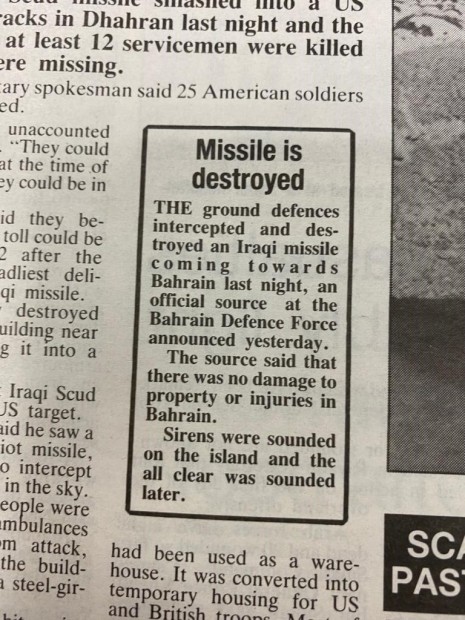
News of missiles being intercepted
Bahrain was part of a 39 countries strong coalition of forces opposing former Iraqi dictator Saddam Hussein, making it a target for Iraq’s Scud missiles.
Journalist and Bahrain University director of media and university relations Ghassan Al Shehabi described the atmosphere at the start of the offensive.

Mr Al Shehabi
“There was a lot of tension in the air and people were stockpiling food and dried goods as advised because they didn’t know what would happen during the war,” said Mr Al Shehabi.
“We were advised to put tape on the windows in the shape of an X to stop the glass from shattering inside the house in case there was a missile strike and this caused the prices of tape to skyrocket – it went up from BD1 to BD5 in one day!
“After a while people got used to the situation and started going up to the roofs of their homes to watch the Patriot missiles intercept the Scuds, it became a spectacle.
“Many missiles were shot at Bahrain but were stopped by the Patriot rockets and one of them landed in Awali.
“The Scuds were modified Russian ballistic missiles that the Iraqi forces modified to increase their payload and range ... at the cost of accuracy.
“People in Awali heard a large explosion unlike anything they heard before, they knew it was a missile strike but it wasn’t a populated area. A part of this missile was later put on display at the Bahrain National Museum.”
Bahrain and surrounding Gulf states were also hit when Iraq dumped six million barrels of oil into the sea and blew up oil wells which caused massive smoke emissions.
The business community was hugely affected too. As a journalist at the time Mr Al Shehabi remembers how all advertising stopped in the newspapers because no one was sure when or how it was going to end. “Many businesses had to make special arrangements with the banks to provide funding so that they could continue,” said Mr Al Shehabi.
“CNN started covering the war live and for the first time people had a 24-hour news channel.”
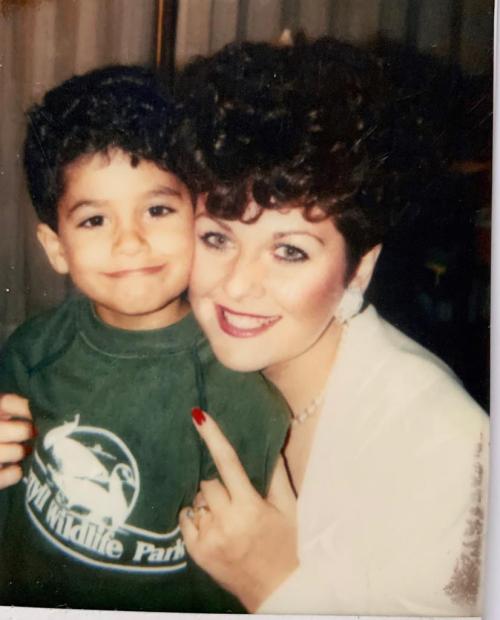
Mrs Mathieson and her son Tariq
Long-term British resident and This Is Bahrain president Betsy Mathieson told the GDN that although carrying a child at the time she never felt in danger thanks to the community and Bahrain’s defence forces.
“I was pregnant with my second son and flown overnight to London and when I landed that’s when we got news of the invasion, my family was saying it was too dangerous to return but I wanted to come back because it was my home,” said Ms Mathieson.
“During that period I never felt unsafe. I felt very confident that the situation was under control. I recall going to the British Club to receive a gas mask, there were British officers handing them out and showing us how to put them on.
“I was heavily pregnant and I’m very claustrophobic, it was very busy and I actually fainted. I felt the British spirit as everyone rushed to help me.
“I remember Bahrain took in many Kuwaiti families, the houses that were recently built in Hamad Town and the late Amir said to give the keys to the houses to refugees.
“There was a great sense of community and camaraderie and the Bahrainis took special care of the expat community. They would check on their neighbours and cook for them and call them to make sure they were OK.”
Ms Mathieson said that her hero was her eldest son, Tariq, who although only five-years-old at the time, kept reassuring her that ‘everything was going to be alright’.
One hundred hours after the ground campaign started, the late US president George H W Bush declared a ceasefire, and he also declared that Kuwait had been liberated.
ghazi@gdn.com.bh
&uuid=(email))