

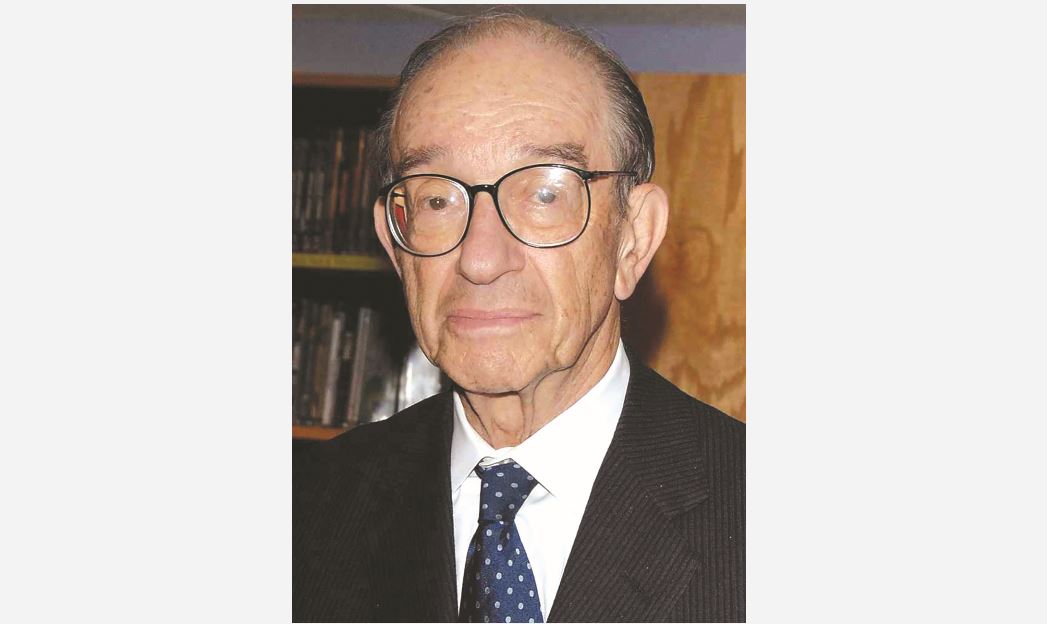
Alan Greenspan, hailed as the greatest Federal Reserve chairman when he retired in 2006 but derided for a severe financial crisis that followed barely two years later, died yesterday aged 100, his wife said.
Greenspan, who exerted a powerful influence on the US economy during his tenure at the helm of the Fed from August 1987 to January 2006, died at his home from complications of Parkinson’s Disease, Andrea Mitchell said in a statement.
“He was a giant of a man who helped shape the US economy for decades under presidents of both parties, but was always honest in acknowledging his mistakes,” Mitchell said.
Greenspan oversaw the second-longest economic expansion in US history, an uninterrupted decade of growth from March 1991 to March 2001. His decision to let the economy run – despite pressure to raise interest rates against an inflation threat that never materialised – helped foster years of US prosperity and earned him rock star status as an economic “maestro.”
The era was marked by his prescient judgement that a productivity surge in the mid-1990s would keep inflation contained.
He also steered the US economy through the 1990-91 recession, the 1997-1998 Asian and Russian financial contagion, the collapse of the dot-com stocks bubble in 2000, and the turbulent economic aftermath of the September 11, 2001, attacks.
The second-longest-serving Fed chair behind William McChesney Martin, Greenspan was first tapped by President Ronald Reagan in 1987 and was later re-appointed by Presidents George H.W. Bush, Bill Clinton and George W. Bush.
&uuid=(email))