

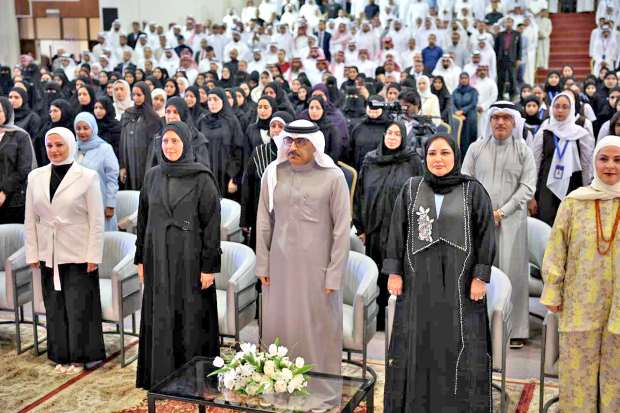
Bahrain has become the first country in the region to introduce the prestigious International Baccalaureate (IB) programme in government schools, marking what Education Minister Dr Mohammed Mubarak Juma described as a transformative milestone in the kingdom’s long-term strategy to ensure the education offerings align with the best globally.
Speaking during a national meeting with parents of successful applicants at the Education Ministry Hall in Isa Town yesterday, Dr Juma revealed that 400 students have been selected from a highly-competitive pool of 3,000 applicants, following one of the toughest academic screening processes introduced in Bahrain’s public education system.
The selected students, all entering Grade Eight in September 2026, will begin the International Baccalaureate Middle Years Programme (MYP) before progressing through the Diploma Programme in secondary school, with the first graduating batch expected in June 2031.
“Today represents a very important milestone for Bahrain,” Dr Juma said.
“Introducing IB into public schools was a dream for me and for the Education Ministry team.
“It was also a major challenge that required extensive co-ordination with the International Baccalaureate Organisation (IBO).
“We worked on every logistical, academic and manpower requirement to make sure we fulfil the programme’s international standards.”
A total of 379 students accepted were government school pupils with only 21 transferred from the private schools system.
The evaluation process required students to meet a minimum 95 per cent GPA, while assessments included:
* Academic performance over the previous two years.
* English Aptis examination.
* Mathematics and Science examinations.
* Personal interview.
* Participation, activities and volunteer work.
* Application evaluation.
“Students had to go through English language tests, mathematics tests, science tests and personal interviews in addition to reviewing their academic performance records, making the process very challenging,” Dr Juma said.
“We selected only the very best students. Even teachers assigned to the programme had to go through their own competency filtering process.”
The successful children were delighted.
Among those selected was 13-year-old Mariam Al Owainati, who told Gulf Daily News she was excited to be part of a historic first.
“I worked very hard for this and I feel proud to be among the first students chosen. This opportunity will help me reach my ambitions and push me to achieve more.”
Fellow student Ali Al Salad, also 13, said competition had been intense.
“Thousands applied so being selected feels like a huge achievement. I know the programme will be difficult, but I’m ready to work harder and prove Bahraini students can compete internationally.”
A total of 16 schools – eight intermediate and eight secondary schools – have been selected for implementing the course, with mathematics and science to be taught entirely in English using internationally-aligned curriculum materials.
“Students who don’t reach expectations will be returned to mainstream education – others in line will replace them,” he said.
Dr Juma stressed that the IB project is only one pillar of a much larger educational reform programme aimed at raising Bahrain’s competitiveness globally.
“We are creating a competitive educational environment. Schools will compete, students will compete and parents will compete. This will positively reflect on outcomes across the entire education system.”
Some private schools in Bahrain have offered IB since the 1990s.
One major achievement highlighted by the minister was the progress of Bahrain University, which has entered the Times Higher Education World University Rankings for the first time since its establishment in 1986.
The university is currently ranked between 1,001 and 1,200 globally, with ambitions to rise rapidly.
“Our next phase is to move from the top 1,000 universities into the top 500 universities globally. We are moving in the right direction – IB as one pillar and many other ideas.”
Bahrain’s education transformation is also being driven by rapid technological expansion.
The ministry has launched B-SERA, an advanced artificial intelligence-powered digital learning platform providing services to students, parents and educators.
Meanwhile, Bahrain has emerged as a global leader in educational technology integration through the Microsoft Showcase Schools Programme.
In 2025, Bahrain achieved:
• 130 Microsoft Showcase Schools – with 125 government schools and five private schools participating.
The digital empowerment drive among teachers has also accelerated sharply.
Latest ministry figures show:
• 11,092 teachers completed training on Ethical Principles for the Use of Artificial Intelligence in Education.
• 814 teachers are now producing digital educational content.
• 5,113 teachers hold Expert Teacher Certification.
Bahrain ranks second globally after India in the number of digitally-certified expert teachers.
Dr Juma said Bahrain’s leadership has strongly backed efforts to excel.
“The showcase programme required a team capable of taking on major challenges. Bahrain’s leadership encouraged us to achieve and remain at the top globally.”
The ministry is also expanding educational inclusion for students with disabilities, with Dr Juma confirming efforts are underway to increase manpower and specialised support.
Current integration statistics show expansion in government schools for students with autism spectrum disorder and special educational needs.
Figures include:
• 382 students with autism spectrum disorder integrated into public schools.
• 67 students with full or partial special needs.
• 286 students with mild intellectual disabilities.
• 51 students with Down syndrome now receiving expanded educational services.
“We are continuously working to increase manpower and capabilities to support students with disabilities and ensure they receive equal educational opportunities,” Dr Juma said.
Among other initiatives, Bahrain has introduced Gaming 100, an elective secondary school course focused on digital game development.
The programme is already producing student-led game projects, helping build future digital talent pipelines.
The ministry has also begun implementing IELTS testing preparation for secondary students, with training launched during the 2023-2024 academic year, allowing students to benchmark international English proficiency standards before university admission.
As Bahrain prepares to launch its first public school IB programme this September, officials believe the initiative signals the beginning of a new era – one designed not only to transform classrooms, but position the kingdom as one of the Middle East’s leading education innovators.
mohammed@gdnmedia.bh