

Kenya has approved a request from the US to open a quarantine facility in the East African nation for Americans exposed to Ebola, US officials told Reuters yestersday, as the head of the World Health Organisation was travelling to the epicentre of the outbreak in Democratic Republic of Congo.
Officials at Kenya’s foreign and health ministries did not immediately respond to requests for comment, but one US officials said the authorisation grants the US access to land at an air force base in Laikipia in central Kenya.
The facility will become operational today with a 50-bed unit, senior US officials said separately.
Health authorities in Congo and neighbouring countries are scrambling to contain the latest outbreak of the rare Bundibugyo strain, for which there is no vaccine or treatment.
However, the outbreak, which is the third largest on record, is outpacing the world’s response.
The approach, which hinges on identifying and isolating potential cases to control the spread of the disease, is weeks, if not months behind the curve and the WHO has declared a public health emergency of international concern.
“16 times, this country has defeated Ebola. The 17th will be no different. But we must act now, together,” said WHO Director-General Tedros Adhanom Ghebreyesus on X, ahead of flying to Congo.
Tedros is due to arrive in Kinshasa and will then travel to Ituri province in Congo’s northeast, where the first Ebola cases were reported and the virus has been circulating for weeks.
In a bid to curb the spread, countries across the world have rolled out travel-related containment measures.
The US has taken some of the strictest, saying it “cannot and will not allow” any cases of Ebola to enter the country.
It temporarily banned the entry of green card holders who have been in Congo, Uganda or South Sudan in the previous 21 days.
The planned facility in Kenya is due to be staffed by members of the US Public Health Service, a uniformed branch of the Department of Health and Human Services.
Kenya had been pushing for the facility to be open to all nationalities, not just US citizens.
It was not immediately clear if that would be the case.
Some Kenyans have questioned why the US would not repatriate citizens exposed to Ebola back home.
“Kenya is a sovereign republic, not a geopolitical isolation ward,” Davji Bhimji Atellah, secretary general of Kenya’s Medical Union, posted on X.
The Katiba Institute, a Kenyan legal advocacy group, filed a lawsuit challenging the US request.
Meanwhile, some experts said the US move could discourage Americans from joining the Ebola response.
“We need a cavalry to help support the on-the-ground response if we have any hope of ending this outbreak. But programs and policies like this are exactly the reasons people will hesitate to sign up,” Craig Spencer, a US doctor who was infected with Ebola during the 2014-2016 outbreak in West Africa and repatriated to the US for treatment, wrote in a blog post.
Since the Ebola outbreak was confirmed in mid-May, there have been 1,077 suspected cases, of which 121 have been confirmed, according to the latest WHO figures, which also showed 246 suspected deaths from Ebola and 17 confirmed fatalities.
Health experts have warned that the real number of cases and deaths is likely to be much higher.
WHO said yesterday it was scaling up testing in Congo in partnership with the country’s national medical research organisation.
But Jean Kaseya, head of the Africa Centres for Disease Control and Prevention (Africa CDC), said that the $500 million initially pledged globally to support the Ebola response had now fallen to around $290m.
“How can we come and say we commit x million dollars, and the next day they are calling me to say no, it was a mistake, we didn’t really want to say that,” he said, while also criticising travel restrictions imposed by Western countries on travellers from Africa.
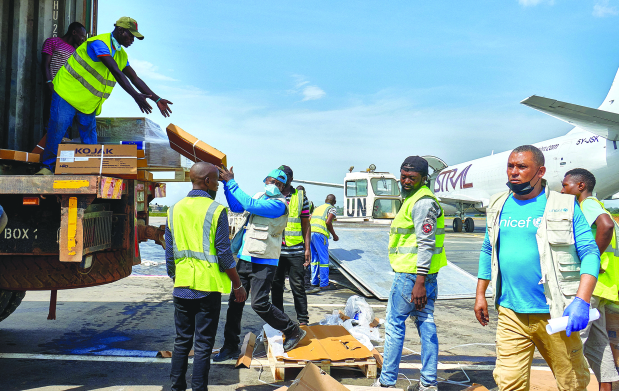
MONUSCO, the UN peacekeeping mission in Congo, said it had shipped just under five tonnes of medical cargo to Ituri yesterday, the latest in a series of flights to deliver supplies.
However, three humanitarian officials involved in the Ebola response in Congo said that continued restrictions on flights in and out of Bunia, the capital of Ituri province, were hampering operations.
One humanitarian official said that despite promising to grant ad hoc exemptions for aid workers, the ministry of transport was not processing them.
&uuid=(email))