

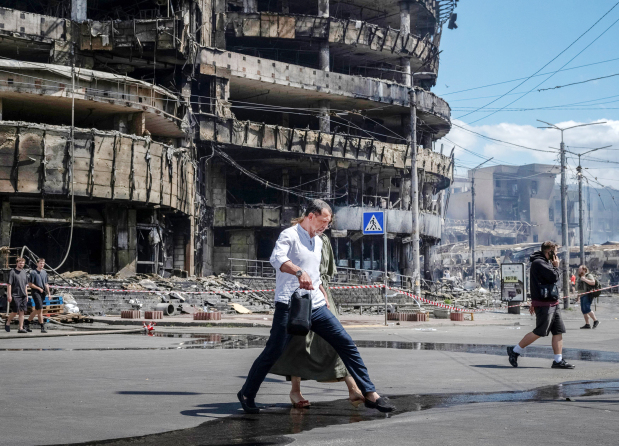
Russia pounded Kyiv and surrounding areas with hundreds of drones and missiles yesterday in one of the heaviest bombardments of the city since the start of the four-year war, firing an Oreshnik hypersonic missile near the capital.
Russia’s hours-long overnight barrage killed four people and wounded nearly 100, according to Ukrainian officials, and authorities said dozens of residential buildings and several schools had been damaged, many in the centre of Kyiv.
“It’s important that this does not remain without consequences for Russia,” President Volodymyr Zelenskiy said on the Telegram messaging app, urging Ukraine’s allies to act. “Decisions are needed – from the United States, from Europe and others.”
European leaders condemned the attack, with Britain and Germany describing the use of the Oreshnik – an intermediate range missile capable of carrying nuclear warheads – as an “escalation”.
Kaja Kallas, the European Union’s top diplomat, accused Moscow of resorting to “a political scare-tactic and reckless nuclear brinkmanship”.
The attack caused minor damage to Ukraine’s cabinet building and to the Foreign Ministry.
Kyiv’s national art museum and philharmonic hall, both in the heart of the city, were badly damaged, officials said, with many other historic buildings in the city centre also affected.
“This is a war against our culture, memory, and identity,” Zelenskiy’s top aide Kyrylo Budanov said. “For centuries, Moscow has tried to destroy everything that makes us Ukrainian.”
One of the strikes destroyed a newly opened museum commemorating the 1986 Chernobyl nuclear disaster, eliciting angry words from Zelenskiy when he visited the scene.
At a city centre cafe which had celebrated its opening on Saturday, staff were sweeping up glass and rubble yesterday. Despite the damage, they continued to serve customers, some of whom said they had come to show their support.
It was only the third time that Russia has used the Oreshnik missile against Ukraine since the war began with Russia’s full-scale invasion in February 2022. The Oreshnik has a range of several thousand kilometres.
The previous two strikes had hit major cities, but Zelenskiy said this one had struck Bila Tserkva, a city of 200,000 people that lies 64km from the outskirts of Kyiv.
The Oreshnik’s warhead appears to have split into 36 submunitions, according to a review of Reuters footage of the strike by Rollo Collins, an investigator at the Centre for Information Resilience, an open-source investigation organisation.
&uuid=(email))