

GCC economies are increasingly shifting from ambition-led expansion to resilience-led development as regional markets decouple from oil price fluctuations to become multi-factor equity markets, experts have concluded.
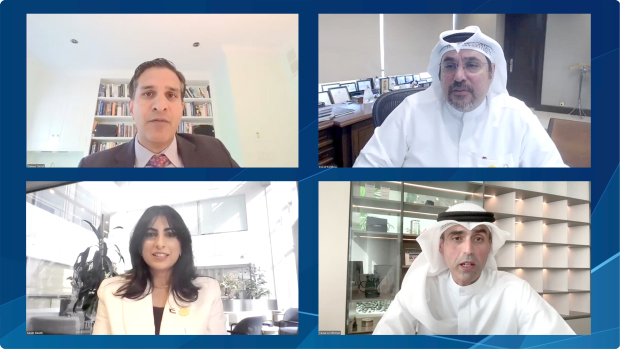
During a high-level webinar titled ‘Regional Geopolitical Developments: Economic Impact and Investment Outlook,’ hosted by Kamco Invest and PGIM, a panel of global and regional specialists analysed the fallout of the ongoing conflict between Iran and the US-Israel axis. The session featured PGIM vice-chair and chief global economist Daleep Singh, Kamco Invest chief executive Faisal Sarkhou, and vice-president of equity and fixed income Sarah Dashti.
The panel highlighted that the current geopolitical climate is accelerating a transition towards a fragmented global economy where economic policies and capital flows are increasingly dictated by geopolitical considerations rather than pure market efficiency. While energy markets and trade routes have faced immediate volatility – driving up commodity costs and complicating central bank efforts towards monetary easing – the experts noted that two interest rate cuts are still anticipated this year.
Despite the heightened risk premiums, the discussion underscored the notable stability of GCC markets, noting that the region is no longer a simple proxy for oil.
Instead, markets now reflect a framework driven by earnings quality, dividend sustainability, and the massive influence of sovereign wealth funds, which command nearly a third of global sovereign assets. The speakers noted that the GCC growth story remains intact, though they observed a reordering of priorities towards strategic autonomy, which includes a sharpened focus on logistics, energy security, and digital infrastructure.
The webinar found that GCC markets are not moving as a uniform bloc but are instead defined by country-specific dynamics. Saudi Arabia is acting as a regional stabiliser due to its significant market depth and liquidity, while Kuwait is maintaining a defensive profile supported by quality valuations and stable names.
Meanwhile, the UAE is exhibiting higher volatility but simultaneously offering selective recovery opportunities. This divergence means alpha generation for investors is now driven by specific country and sector allocation rather than broad regional exposure.
Looking ahead, the panel outlined three potential paths for the regional and global economy. In the base case of a fragile ceasefire, they expect continued volatility with elevated oil prices and delayed monetary easing. A more constructive scenario involving a negotiated settlement could lead to easing inflationary pressures and improved global risk sentiment.
Conversely, a re-escalation of tensions would likely result in severe supply disruptions, sharply higher energy prices, and increased global recession risks. The experts urged investors to adopt scenario-based strategies, focusing on real assets and portfolio diversification as the global economy adjusts to an uncertain but opportunity-rich landscape.
avinash@gdnmedia.bh
&uuid=(email))