

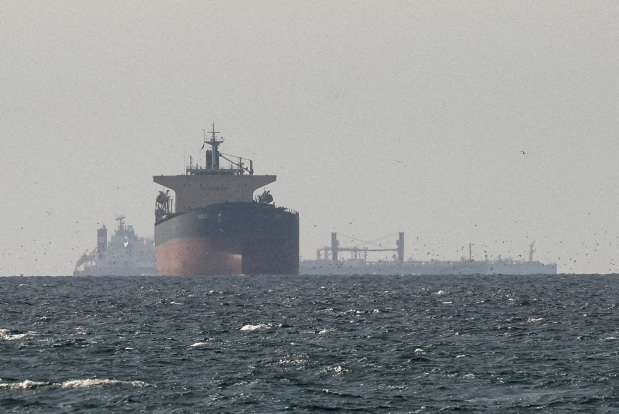
US President Donald Trump warned Iran not to charge tolls on ships crossing the Strait of Hormuz as still-stalled Gulf tanker traffic prompted Japan to announce a further emergency oil release yesterday.
The Iran war has damaged Gulf energy production, frozen exports, and boosted oil prices by about 50 per cent in the world’s worst energy shock, with Asian buyers among the hardest hit.
“There are reports that Iran is charging fees to tankers going through the Hormuz Strait,” Trump wrote in a post on Truth Social.
“They better not be and, if they are, they better stop now.”
“That is not the agreement we have!” Trump said.
Iran planned to demand tolls in cryptocurrency during the ceasefire, Hamid Hosseini, a spokesperson for Iran’s Oil, Gas and Petrochemical Products Exporters’ Union, had told the Financial Times newspaper.
British Prime Minister Keir Starmer said yesterday that he and Trump had discussed how to open the strait a day earlier.
“We’ve been pulling together a coalition of countries... working on a political, diplomatic plan, but also looking at military capabilities and... the logistics of actually moving vessels through the strait,” Starmer said.
A re-opening of the waterway would free hundreds of stranded tankers and other vessels, and was a condition of the two-week ceasefire announced on April 7.
Yesterday, just one non-Iran-related major vessel had crossed the strait to exit the Gulf in the last 24 hours, according to ship-tracking data, versus about 140 transiting normally.
The Panama-flagged cargo ship Oceana Sky sailed from Iraq’s port of Khor Al Zubair and is bound for Jordan, data on the Kpler and Lloyd’s List Intelligence platforms showed.
On Thursday, Iran’s Islamic Revolutionary Guard Corps set forth a special route for vessels to follow, warning them to sail through Iranian waters around Larak Island to avoid the risk of naval mines in the usual lanes through the strait, Iran’s semi-official Tasnim news agency reported.
The Oceana Sky complied with the new route, LSEG ship-tracking data showed.
Japan plans to release an additional 20 days’ worth of oil reserves from May, Prime Minister Sanae Takaichi told a cabinet meeting yesterday.
Japan is dependent on the Gulf for some 95pc of its oil.
Takaichi said by May the country should be able to secure more than half of its imports via routes that bypass the Strait of Hormuz, without providing details.
With the Gulf effectively shut, Saudi Arabia is managing to export via the Red Sea port of Yanbu.
Japan in May is also set to receive four times the US crude it did a year earlier, a trade and economy ministry document showed yesterday.
Saudi overnight updated its production status, with state news agency SPA reporting that Iranian attacks had cut oil production capacity by around 600,000 barrels per day and flows on its East-West
Pipeline to Yanbu by about 700,000 bpd.
Top exporter Saudi Aramco has asked its clients to submit nominations for May cargoes loading from Yanbu and Ras Tanura, two sources said, with Ras Tanura loadings dependent on the strait reopening.
Kuwait Petroleum Corp (KPC) has provided April loading dates, two sources said, but these also depend on strait sailings resuming.
Last month, KPC declared force majeure on deliveries in light of the Gulf being closed.
Iran’s exports remain largely unfettered, with a supertanker that can carry 2 million barrels of oil, a bunkering tanker and a smaller oil ship leaving Iranian anchorages in the past 24 hours, ship-tracking data showed.
Chinese independent “teapot” refiners, Iran’s biggest buyers, are paying premiums to Brent for the first time in years, sources told Reuters.
At least two refiners in Dongying, Shandong province, paid premiums of $1.50 to $2 a barrel for Iranian Light this week, trade sources said.
That compared with a $10 per barrel discount before the conflict.
&uuid=(email))