

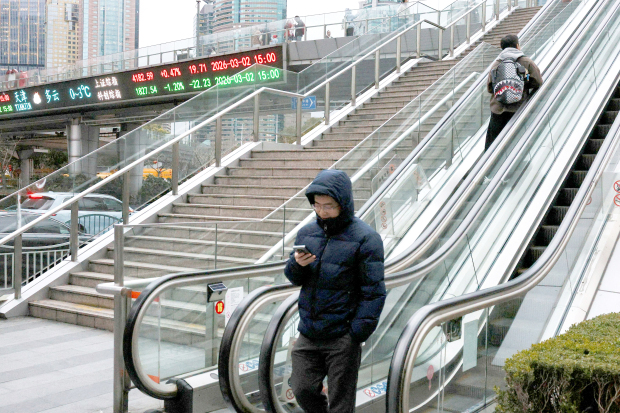
JAPANESE and South Korean equities rose in thin holiday trade yesterday with strength in technology shares, while investors watched for updates in the ongoing US-Iran war.
Wall Street indexes ended little changed overnight, while futures tied to them were largely muted in Asian trading on Friday.
Trading volumes remained subdued, with several major regional markets, including Hong Kong, Australia, and Singapore, closed for the Good Friday holiday.
Japan’s Nikkei 225 advanced 1.2 per cent, while South Korea’s KOSPI jumped nearly 3pc, supported by strength in technology shares.
Investor sentiment steadied on Thursday after Iran said it was working with Oman on a framework to manage shipping traffic through the Strait of Hormuz.
However, caution persisted following escalating rhetoric from US President Donald Trump. In a Truth Social post late Thursday, Trump warned that US forces had “not even started” their campaign in Iran and could next target critical infrastructure, including bridges and electric power plants.
The comments followed a speech earlier in the day in which Trump said the US could intensify military action in the coming weeks, while offering little clarity on a timeline for de-escalation, unsettling global markets.
Oil prices surged above $110 per barrel on Thursday on escalation fears.
In China, data showed that services sector growth cooled in March, with the RatingDog Services PMI falling to 52.1 from February’s 33-month high of 56.7, although it remained in expansion territory.
China’s Shanghai Composite index fell 0.9pc, while the blue-chip Shanghai Shenzhen CSI 300 index edged 0.6pc lower.
Meanwhile, stock markets in the UAE closed mixed yesterday.
Dubai’s main share index dropped 0.5pc, dragged down by a 4.9pc decline in each of blue-chip developer Emaar Properties and its construction arm Emaar Development .
India’s central bank has approved Emirates NBD Bank’s proposal to acquire a majority stake in RBL Bank, the Mumbai-based lender said on Thursday, giving a key regulatory clearance for one of the largest cross-border deals in India’s financial sector.
Emirates NBD Bank shares closed 0.4pc down.
However, Abu Dhabi’s benchmark index edged 0.2pc, supported by a 1pc rise in Abu Dhabi Islamic Bank and 0.4pc hike in petrochemical maker Borouge.
Meanwhile, a fresh read on inflation and initial company results next week could start to show the Middle East war’s effects on the US economy and corporate America, as investors hope to start moving past a conflict that has consumed markets.
Traders were wrestling with conflicting signals about a potential winding down of the war that began over a month ago, with the US-Israeli military strikes on Iran.
The S&P 500 posted a gain in the holiday-shortened week, snapping a five-week streak of losses. The benchmark index earlier in the week closed its worst-performing quarter since 2022, weighed down since late February by the war and the resulting surge in energy prices.
“It’s going to be hard to get the market’s attention off the Middle East, oil prices and the risks that have emerged,” said Matthew Miskin, co-chief investment strategist at Manulife John Hancock Investments. “The markets have been so myopically focused on geopolitical risk and ... how all this is going to shake out.”
Stocks have stumbled this year, with concerns about artificial-intelligence disruption and private credit weakness compounding uncertainty over the Middle East conflict. The S&P 500 was last down nearly 6pc from its late-January all-time high.
The war’s impact on oil supplies and energy prices remained the focal point for investors, especially the status of the Strait of Hormuz, a critical Middle East oil-shipping channel where traffic has stalled. US crude topped $110 a barrel on Thursday after the commodity earlier in the week settled above $100 a barrel for the first time since 2022.
“The market is pricing off oil,” said Doug Huber, deputy chief investment officer at Wealth Enhancement Group. “Inflation expectations, bond markets - everything is stuck to this concept of what oil is doing.”
Next week’s consumer price index, a closely watched inflation gauge, stands as an early test of the war’s energy shock. With US crude jumping some 90pc since the start of the year, the US average petrol price rose above $4 a gallon this week for the first time in more than three years.
“We think the first stage of oil price pass-through will have arrived in March via motor fuel,” BNP Paribas said in a note previewing the CPI report.
The March CPI report, due on April 10, is expected to have climbed 0.9pc on a monthly basis, according to a Reuters poll as of Thursday. Excluding energy as well as food prices, the “core” CPI level is expected to have risen 0.3pc.
Miskin said he would look for “ripple effects” across other goods and services stemming from the war and energy-price surge, while adding that the March report may be too soon to see any broader inflationary impact.
“You’re just trying to get as much real-time data as you can to formulate where the inflation and economic growth trends are going,” Miskin said.
&uuid=(email))