

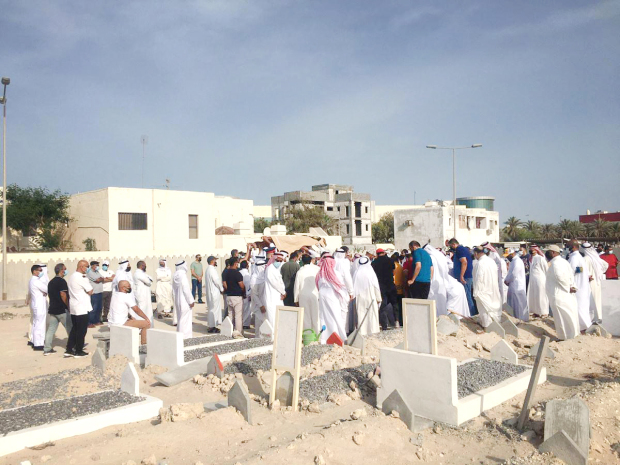
A call has been made to upgrade infrastructure in Muharraq cemeteries, with municipal representatives claiming that families were struggling to conduct burials after dark owing to inadequate lighting.
Muharraq Municipal Council members stressed that while some areas of the main Muharraq Cemetery and other graveyards in the governorate were well-lit, large sections remain in complete darkness, creating what they described as a ‘catastrophic situation’.
They explained that families were often forced to postpone burials until daylight hours, which, they argued, deprived mourners of valuable time to receive condolences during the traditional three-day paid leave period granted for bereavement.
Council chairman Abdulaziz Al Naar said that night burials have increasingly become the norm in Bahrain, but the lighting infrastructure in Muharraq has not kept pace with this reality.

Mr Al Naar
“The truth is that the majority of funerals today are held in the evenings, especially during the hot summer months when temperatures rise,” said Mr Al Naar.
“But the existing lighting in Muharraq Cemetery does not support this. It is insufficient and in many sections completely absent – and that is simply unacceptable for families in mourning.”
He pointed out that while some villages across Bahrain have managed to instal floodlights through donations from philanthropists, often with the approval of the Waqf directorates concerned, the vast size of Muharraq Cemetery makes such efforts more difficult to achieve.
The issue was formally raised during the council’s latest meeting, with councillors insisting that immediate upgrades were necessary to ensure dignity, safety and accessibility for both mourners and workers during night funerals.
Council’s services and public utilities committee chairman and Muharraq Cemetery area councillor Abdulqader Al Sayed underlined the need to replace and upgrade the current lighting system, which he said suffers from frequent technical faults.
“Muharraq Cemetery’s lighting breaks down repeatedly, leaving mourners and funeral workers struggling in darkness,” said Mr Al Sayed.

Mr Al Sayed
“This is not only distressing for families, but also hinders the smooth running of burials. We are pressing for comprehensive renewal of the entire system so it can meet today’s needs.”
He also noted that the lighting issue has been left unresolved for long despite repeated complaints.
“The council will continue to push for the ministry and the Waqf authorities to allocate the necessary resources. This is a basic service and it must be treated as a priority,” he said.
Council vice-chairman Saleh Buhazaa added that the problem was not limited to the main Muharraq Cemetery, stressing that other burial grounds in the governorate and beyond also required immediate attention.

Mr Buhazaa
“The case of Qalali Cemetery, for example, is pressing,” said Mr Buhazaa. “Its lighting is poor, and the whole site requires an upgrade. The lack of proper illumination is a huge obstacle during funeral processions at night, and this creates unnecessary hardship for both workers and mourners. A comprehensive plan is needed to improve lighting across all cemeteries in Muharraq, rather than relying on piecemeal solutions.”
Councillors stressed that while philanthropic initiatives had helped in smaller villages, larger sites such as Muharraq Cemetery require government support due to the scale of the work and associated costs.
The issue will now be followed up with the relevant ministries and the Jaafari and Sunni Waqf directorates, with councillors vowing to keep the matter on the agenda until concrete action is taken.
mohammed@gdnmedia.bh